Providing sustainable drinking water as the community grows is the Region of Waterloo's top priority. As we address the water capacity constraint in the Mannheim Service Area, these updates share our progress. 

In the September 14 issue: 📆

Side stream pilot project nearing completion

New approaches to key projects will bring more water online faster

Groundwater Interference Policy updated


Side stream pilot project nearing completion

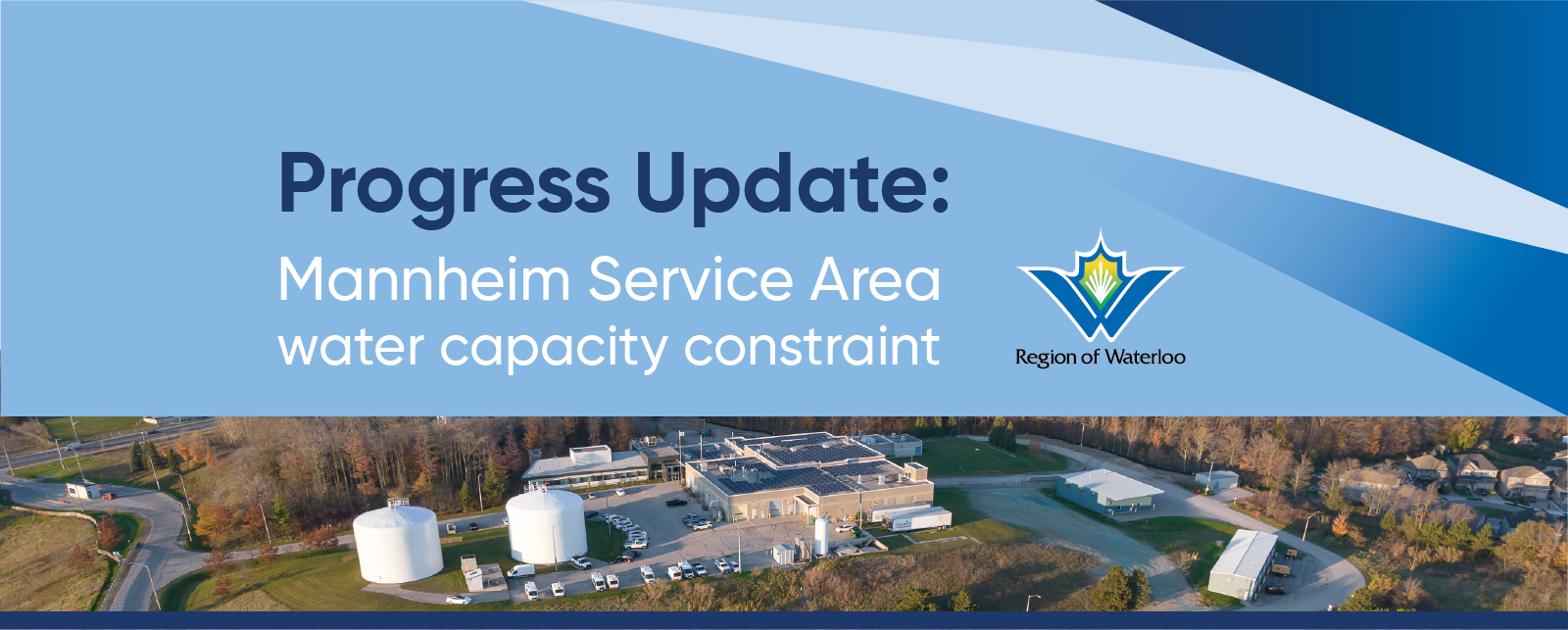
Site preparation work is almost complete on the first side stream unit at the Mannheim Water Treatment Plant, which will add 20 L/s of new capacity to the Mannheim Service Area this fall. The first side stream unit arrived in August, and extensive electrical and piping work has now been done to connect it to the treatment plant.

This is a pilot project, with three more similar units set to arrive in the near future. Concrete pads have now been poured at the plant to be ready for their arrival.

Follow along for more progress updates on Facebook, Instagram, LinkedIn, YouTube, and X.   


New approaches to key projects will bring more water online faster

Region of Waterloo staff have identified new approaches to provide additional capacity to the Mannheim Service Area earlier and at a lower cost. Based on council directives and additional information collected in recent months, the Region has identified a plan to move an estimated 25 L/s of water demand from the Mannheim Service Area to the Middleton Service Area. This reconfiguration will be three years faster, cost $8.1M less, and be permanent compared to building the temporary CAM 2W pumping station. 

The Region is also proceeding with an alternative solution that will deliver more water from the Parkway Water System. A blending approach will allow 10 L/s more water to be online in 2027 and cost an estimated $1.8M. This will save $2.9M and be delivered two years earlier compared to the option of building a new water treatment process.   

After allocating an additional 15 L/s from Wilmot to the Mannheim Service Area on an interim basis, and after bringing more water online faster than anticipated, the 15 L/s will no longer be needed after January 2027, at which point it will be available to be used to support growth in Baden and New Hamburg.  

The Region continues to explore all options to address the capacity constraint and find efficiencies where possible. 
 

Groundwater Interference Policy updated 

The Region of Waterloo has a newly updated process for how it responds to groundwater interference claims from private well owners. These changes to the policy are intended to increase transparency and trust. The update includes a new independent investigation process and the development of a well interference appeal committee. More information on the revised well interference policy is available now on the newly created webpage: https://www.regionofwaterloo.ca/programs-and-services/water-and-wastewater/drinking-water-supply/well-interference-claim/


About the water capacity constraint  

The Region of Waterloo operates a complex water system that relies on groundwater and water from the Grand River, with over 100 wells and 50 treatment facilities. In the fall of 2025, through ongoing work and updates to the long-term strategy for water supply, a capacity constraint in the Mannheim Service Area was identified. This service area supplies water to Kitchener, Waterloo and parts of Cambridge, Woolwich, and Wilmot. The constraint is a limit on the Region’s ability to pump, store, treat, and distribute water needed to support future growth, while having capacity for critical maintenance requirements. We are working to accelerate solutions to ensure a safe and sustainable supply of water for generations to come.    


View previous Progress Updates.
View Council reports related to the constraint.

Email waterupdate@regionofwaterloo.ca to receive regular updates.   
Visit the water capacity information hub for more information.
