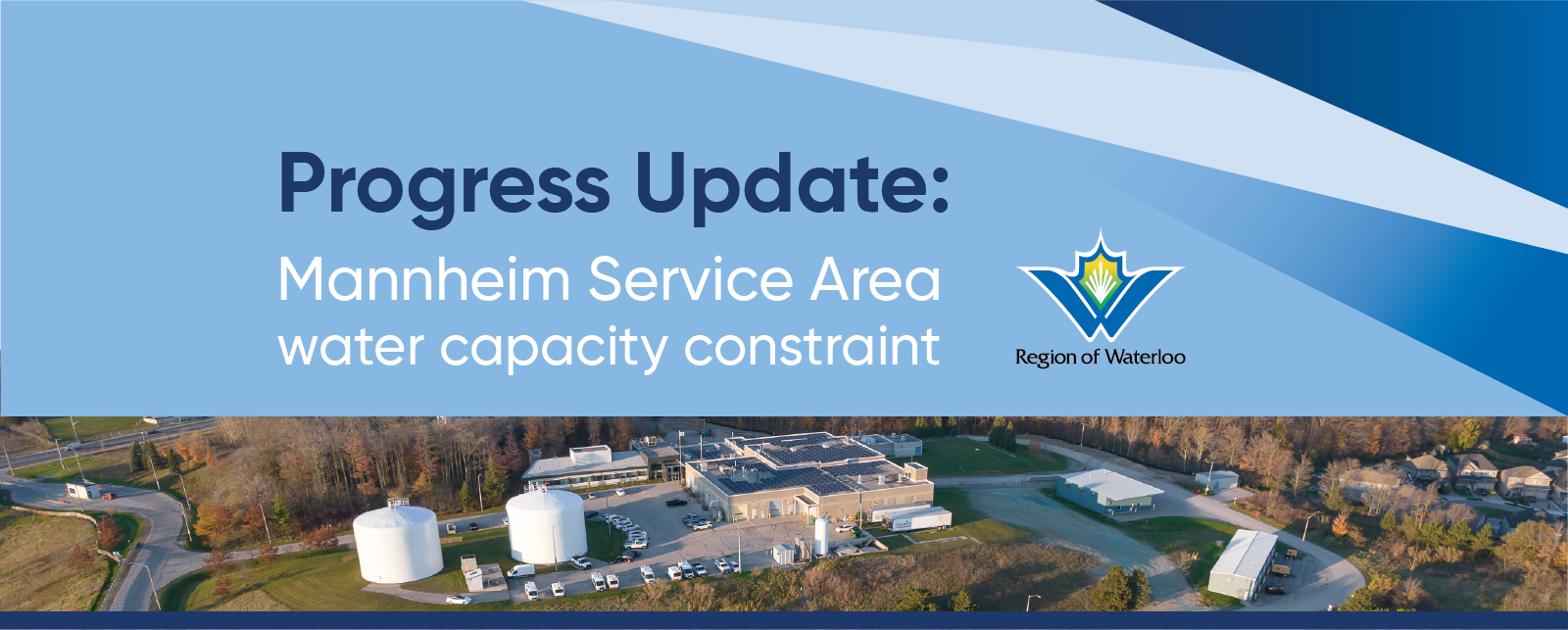
Providing sustainable drinking water as the community grows is the Region of Waterloo's top priority. As we address the water capacity constraint in the Mannheim Service Area, these updates share our progress.
|
|
|
|
In the July 10th issue: 📆
|
|
|
|
Restoring and boosting water capacity
|
This week, a significant increase to water capacity in the Mannheim Service Area was announced. This additional water capacity will ensure a continued safe and sustainable water supply to support community needs.
In July, a total of 30 L/s of water capacity is ready for the Region to assign to area municipalities for projects within the Mannheim Service Area.
A key part of this important achievement was by optimizing existing source well operations more effectively, we were able to unlock an additional 10 L/s of water — that’s enough water for 3,500 people. Learn more about well optimization in the video below, and read more about the additional capacity in this Media Release.
|
|
|
|
Work continues to prepare the Mannheim water treatment plant for a side stream filtration solution that will add 20 L/s of new capacity by the end of September. Last week, helical piles were installed on site. These help distribute the loads from the heavy side stream containers deep underground so that their weight doesn’t damage underground utilities below them, such as pipes and conduits.
Next, the underground piping that will direct flows to and from the containers will be installed, followed by the remainder of the structural support system. The first treatment unit will then be installed later this summer.
Watch the video below to see the first ‘mud mat’ concrete pour, which creates a flat surface above the soil for crews to build out the structural rebar for the next stages of pouring.
|
|
|
|
Supporting continued growth
|
|
|
|
Council has approved an updated framework for Regionally-issued Forward Looking Servicing Agreements (FLSAs) to support continued growth and development while ensuring occupancy remains aligned with the delivery of new water infrastructure.
The framework allows certain plans of subdivision to proceed with plan registration and building permit issuance using water supply capacity aligned with future occupancy of the development. These can proceed provided that occupancy is deferred until future water supply capacity becomes available. To be eligible, a plan must:
|
|
|
|
- have received a draft approval; and
- have submitted a servicing agreement request before May 6, 2026.
|
The updated framework streamlines the process by allowing developers to submit requests tied to specific project milestones and planned water infrastructure projects. This approach provides greater certainty on the timing of future capacity.
Forward Looking Servicing Agreements requested after May 6, 2026 will be processed by Area Municipalities.
|
Transfer framework supports near term development
|
Requests for Transfer Servicing Commitment are being reviewed, and implementation is being expedited to support the transfer of committed water capacity from registered unbuilt lots/blocks to draft approved subdivisions. It is expected this work will allow for over 350 homes to move forward immediately.
|
|
|
|
Expediting water capacity projects
|
Council has approved a new procurement approach to help bring water capacity online quicker while maintaining transparency, accountability, and responsible stewardship of public funds.
The approved approach allows certain procurement requirements to be waived for eligible water-capacity projects identified through the Interim Risk Management Framework and delegates approval authority to the Chief Administrative Officer in specific circumstances where standard procurement timelines could delay project delivery.
The authority applies only to projects with existing Council-approved funding, includes consultation with Procurement staff, monthly reporting to Council, and expires on June 30, 2027.
|
|
|
|
Financial update on water capacity constraint initiatives
|
A financial update was presented to Council on the initiatives required to support long-range planning and decision-making. Staff assessed both the operating and capital commitments associated with addressing the capacity constraint and evaluated the potential impacts of these initiatives on the Water Capital Reserve and future water rate requirements using different funding scenarios.
The Region continues to work closely with the Province to advocate for funding support to help expedite solutions, reduce pressure on the Water Capital Reserve, and minimize water rate increases. Securing external funding remains the most significant factor in reducing future rate pressures. Read the full report.
|
|
|
|
About the water capacity constraint
|
The Region of Waterloo operates a complex water system that relies on groundwater and water from the Grand River, with over 100 wells and 50 treatment facilities. In the fall of 2025, through ongoing work and updates to the long-term strategy for water supply, a capacity constraint in the Mannheim Service Area was identified. This service area supplies water to Kitchener, Waterloo and parts of Cambridge, Woolwich, and Wilmot. The constraint is a limit on the Region’s ability to pump, store, treat, and distribute water needed to support future growth, while having capacity for critical maintenance requirements. We are working to accelerate solutions to ensure a safe and sustainable supply of water for generations to come.
|
|
|
|
|