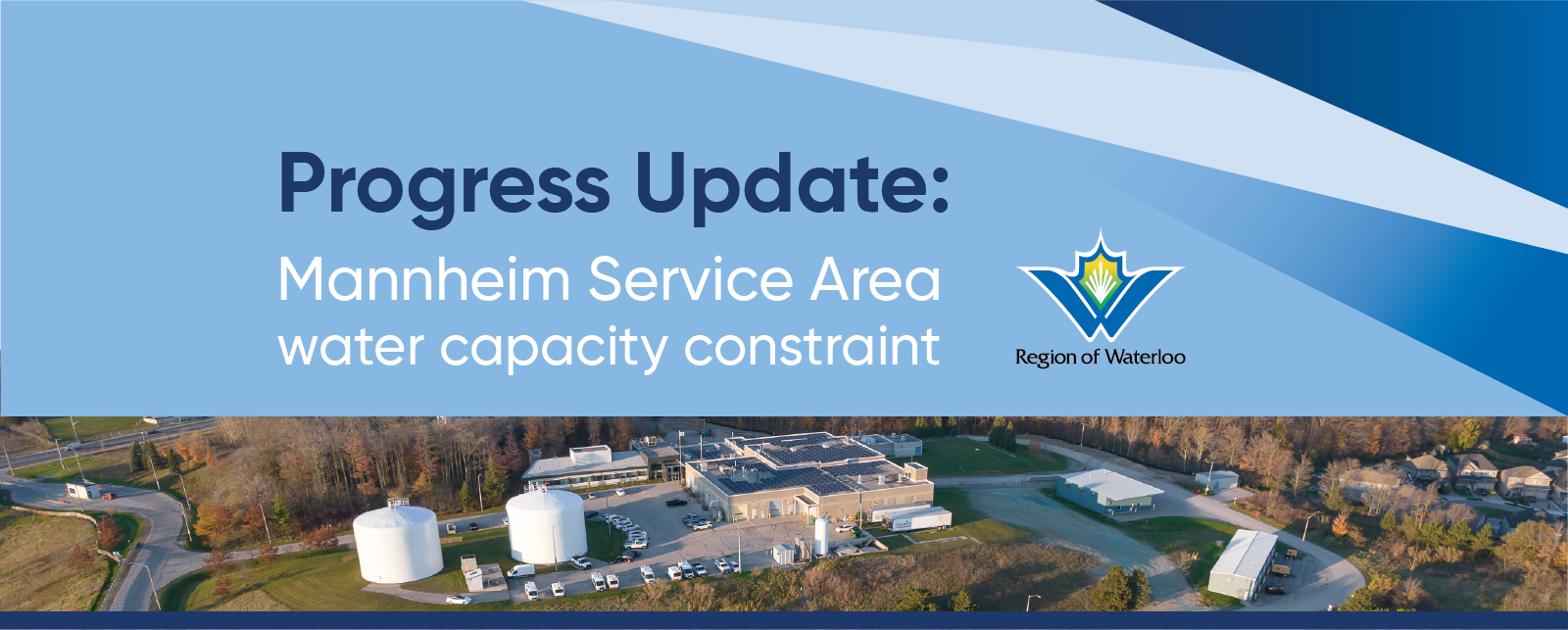
Providing sustainable drinking water as the community grows is the Region of Waterloo's top priority. As we address the water capacity constraint in the Mannheim Service Area, these updates share our progress.
|
|
|
|
In the August 14 issue: 📆
|
|
|
|
First side stream container arrives on site
|
The concrete pad that supports the first unit was poured and cured, allowing the first container to arrive on site. Now that the unit has arrived, site preparation work continues and includes electrical and piping work to connect the unit to the Mannheim Water Treatment Plant. When complete, the first container is expected to add 20 L/s of new capacity to the Mannheim Service Area.
Watch the video below to see the pouring of the concrete pad and the delivery of the unit.
|
|
|
|
The Region has assigned the first batch of water capacity to the Area Municipalities, to be allocated for new development projects. Work to increase water capacity over the past several months has produced 30 L/s in the Mannheim Service Area, which can be used for new development as determined by water allocation policies set by the Area Municipalities. In addition, capacity has been made available to the Area Municipalities for Forward Looking Servicing Agreements, which allows more development to proceed.
|
|
|
|
Work continues at Greenbrook Water Treatment Plant
|
|
|
|
Work is progressing at the historic Greenbrook plant in Kitchener to repair key infrastructure and restore water capacity. New tanks will be installed soon to hold chemicals used in the water treatment process. The plant’s filters that remove iron and manganese are being rehabilitated, as are the site’s GAC (granular activated carbon) tanks. Work is also underway to drain, clean and inspect Greenbrook’s reservoirs and chambers. Renewal of the plant equipment will restore up to 80 L/s.
|
|
|
|
Updates underway to the Groundwater Interference Policy
|
The Region of Waterloo is reviewing how it responds to groundwater interference claims from private well owners. This review focuses specifically on the claim and appeal process, including how concerns are assessed, how decisions are made, and what happens when interference is identified. Staff prepared a draft policy here, and will host a public information session on August 20 from 4 p.m. to 7 p.m. to get more feedback from the community before a final draft policy is brought to Council in September.
|
|
|
|
Transferring water capacity supports immediate development
|
The Region is now facilitating the transfer of committed water capacity from unbuilt lots or blocks to be used instead for draft approved subdivisions. One agreement has been fully executed, and another is in progress. Moving quickly on these Requests for Transfer Servicing Commitment is expected to allow over 350 homes to move forward immediately.
|
|
|
|
About the water capacity constraint
|
The Region of Waterloo operates a complex water system that relies on groundwater and water from the Grand River, with over 100 wells and 50 treatment facilities. In the fall of 2025, through ongoing work and updates to the long-term strategy for water supply, a capacity constraint in the Mannheim Service Area was identified. This service area supplies water to Kitchener, Waterloo and parts of Cambridge, Woolwich, and Wilmot. The constraint is a limit on the Region’s ability to pump, store, treat, and distribute water needed to support future growth, while having capacity for critical maintenance requirements. We are working to accelerate solutions to ensure a safe and sustainable supply of water for generations to come.
|
|
|
|
|